
UAE Crypto Wallet: The Truth About Crypto Tracking
How blockchain analytics is changing fraud and financial crime investigations in the UAE
By Ezat Alnajm
A fraudster receives cryptocurrency, splits it across several wallets, sends part through a mixer, moves another portion onto a different blockchain and eventually deposits the remaining funds into an exchange.
The purpose is straightforward, that is to make the money harder to follow.
But that does not mean the trail has disappeared.
Public blockchains can record transaction histories long after funds have moved. That is why blockchain analytics is increasingly relevant to fraud investigations, suspected money laundering, source-of-funds reviews and disputes involving digital assets.
The important point is not that every crypto transaction can be solved. It is that many seemingly complicated transaction chains can be reconstructed, analysed and turned into usable financial evidence.
Fraudsters Have More Than One Way to Hide the Trail
Crypto-related financial crime rarely involves simply moving money from Wallet A to Wallet B.
One common technique is wallet hopping: repeatedly moving assets through new addresses to create distance from the original source.
Another is chain hopping, where funds move from one virtual asset or blockchain to another, often rapidly. FATF specifically identifies chain hopping as a technique that can be used to frustrate tracing efforts. (FATF)
Then there are mixers and tumblers. These services are designed to make the connection between sending and receiving addresses more difficult to establish by pooling or rearranging transactions from multiple users. FATF expressly identifies mixers and tumblers as mechanisms used to conceal that relationship. (FATF)
A fraud trail might therefore look like this:
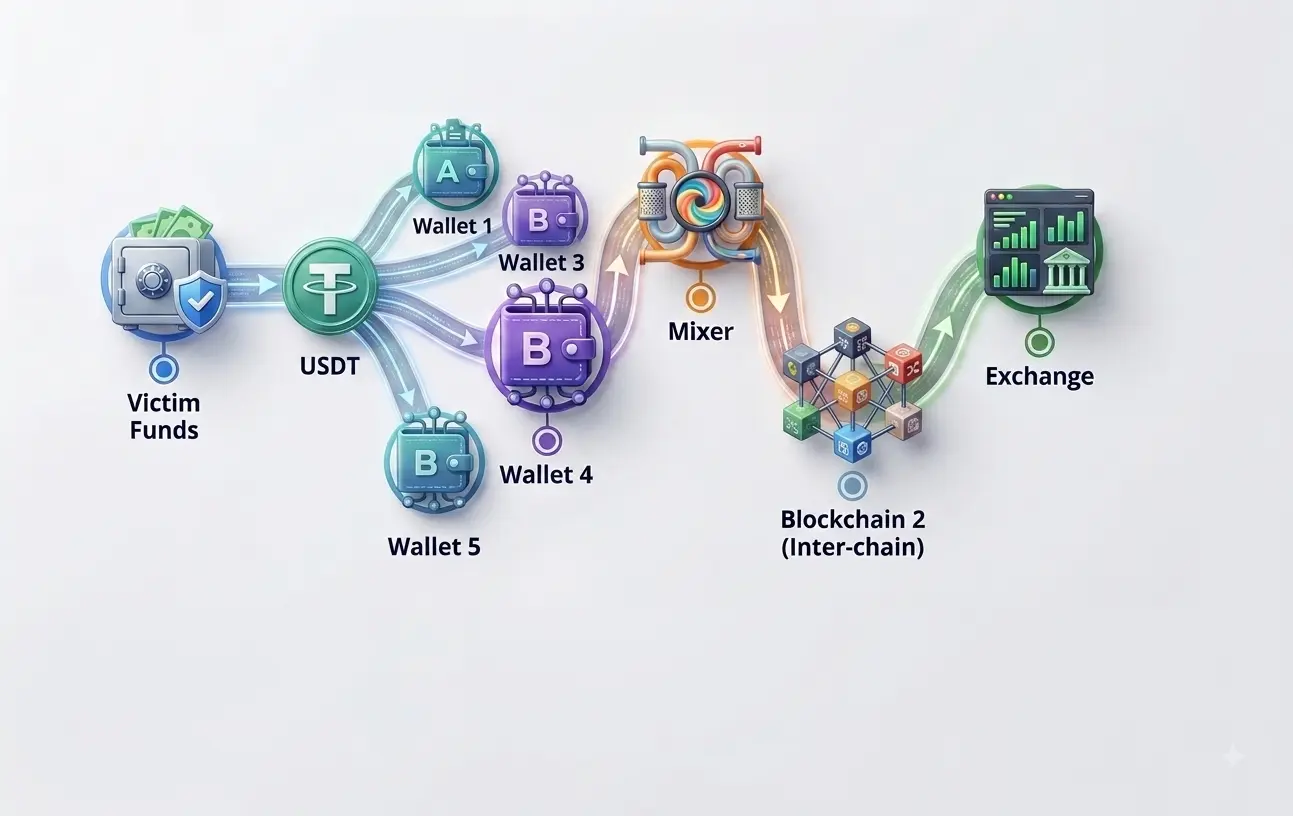
Victim funds → USDT → five wallets → mixer → another blockchain → exchange
At first glance, that can appear impossible to untangle.
It is not necessarily impossible. It simply requires a different type of financial investigation.
The Investigation Starts by Reconstructing the Money
Suppose an investor transfers AED 250,000 to what appears to be a legitimate investment business. The money is converted into USDT and transferred to a wallet.
The assets are divided across six addresses within 30 minutes that makes the flow of funds harder to follow. Three of those wallets later send funds into the same destination. Another portion enters a mixer, while the remainder moves through a cross-chain bridge and appears on another blockchain.
A useful investigation would not stop after identifying the first receiving wallet.
The transaction history can be reconstructed to identify where funds split, where they reconverged, how quickly they moved, which services they interacted with and where they ultimately reached identifiable infrastructure.
This can reveal something that is often more important than an individual transaction: behaviour.
Six wallets that repeatedly receive and move funds together may suggest a relationship. Rapid transfers immediately after receiving fraud proceeds may deserve scrutiny. Interaction with known high-risk services, mixers or previously identified illicit addresses can add another layer of risk.
None of those facts alone proves criminal conduct. But taken together, they can significantly change the financial picture.
Crypto Wallet Tracing: From Wallet Addresses to Identifying Evidence
There is an important limitation.
Blockchain analytics can often establish that a transaction occurred between two addresses. It does not automatically disclose who owns those addresses.
That is why good crypto investigations do not remain entirely on-chain.
If traced funds eventually reach a regulated exchange, the investigation has potentially reached an important identification point. VARA requires licensed Virtual Asset Service Providers to conduct customer due diligence and verify clients and beneficial owners in relevant circumstances. (VARA Rulebook)
VARA also requires VASPs to maintain risk rules for screening clients, beneficial owners, virtual-asset transactions and wallet addresses. (VARA Rulebook)
The UAE Virtual Assets Travel Rule adds another layer by requiring originator and beneficiary information in relevant transfers and imposing enhanced due diligence requirements around transactions involving unhosted wallets. (Central Bank Rulebook)
This means an investigation may progress from:
Where did the crypto go?
to:
Which regulated institution received it, and what records may exist there?
Accessing those records is a separate legal or regulatory process. But identifying where the relevant evidence is likely to exist can be a critical part of solving the case.
Understanding the Challenges of Tracing Crypto Through Mixers
Mixers are purposefully designed to weaken the direct transaction link between incoming and outgoing cryptocurrency.
That makes forensic analysis harder.
But harder is not the same as useless.
Investigators can examine the assets entering the mixer, timing, transaction values, subsequent wallet behaviour, destination services and other available evidence .It may not be possible to follow the money in a straight line, but the analysis can still uncover useful links and point to the evidence needed next.
Cross-chain activity presents a similar challenge. An investigator may need to follow the economic value rather than simply one token, tracing the movement through bridges and onto another blockchain.
The regulatory approach in the UAE also recognizes this type of risk brought about by technologies intended to delete any information and transactional data.UAE VASPs are prohibited from executing transfers involving privacy tokens because of their potential to hide transaction details and increase financial-crime risks. (Central Bank Rulebook)
The Fraud Often Begins Before Crypto Appears
The most important element of any crypto financial crime is to realise that the stats and patterns within your data rarely make up a complete case.
The fraud may begin with a fake investment platform, an impersonated executive, a fraudulent invoice, social engineering or a bank transfer.
That creates an off-chain trail.
There may be bank statements showing the original AED transfer, WhatsApp conversations, email correspondence, invoices, exchange confirmations and identity documents.
Then there is the on-chain trail showing what happened after the funds became cryptocurrency.
The strongest financial crime analysis connects them.
That can transform a case from:
“I sent AED 250,000 and the money disappeared into crypto.”
into a documented chronology showing when the fiat payment occurred, when it was converted, which wallet received the virtual assets, how the funds were subsequently layered and where identifiable endpoints appeared.
That is much more useful to a lawyer, bank, compliance department or investigative authority than hundreds of raw transaction hashes.
A Financial Crime Report Has to Explain What Actually Happened
Wallet tracking by itself is only one part of the exercise.
A meaningful financial crime report should distinguish between confirmed transactions, identifiable risk indicators, reasonable analytical conclusions and facts that cannot yet be established.
It should explain which wallets matter, how the assets moved, whether concealment techniques such as mixers or chain hopping were involved, where regulated counterparties appeared and what evidence may need to be obtained next.
That distinction matters particularly when findings could eventually support litigation, a criminal complaint, a banking review or an AML investigation.
Blockchain analytics should not promise certainty where none exists.
Its real value is in taking a complicated digital transaction history and turning it into a clear financial reconstruction.
Crypto Wallet in UAE: Bottom Line on Crypto Transactions
Digital assets have undoubtedly given fraudsters new ways to move money quickly across wallets, platforms and borders.
But they have also created something unusual.
A cash payment can disappear without leaving a detailed public history.
A public blockchain transaction may remain visible years later.
Fraudsters can use mixers. They can move between blockchains. They can split funds across dozens of wallets and attempt to layer the proceeds through multiple services.
What they cannot safely assume is that entering the crypto ecosystem automatically erases the financial trail.
In many cases, the opposite is becoming true.
The more complicated the movement of funds becomes, the more important professional reconstruction becomes in explaining where the money went, how it was concealed and where the investigation should go next.
For investors and businesses with exposure to digital assets, understanding crypto tax compliance in the UAE is also key when assessing transaction records and wallet activity. Talk to the experts for professional guidance on crypto tax compliance and reporting. Email us at info@tulparblockchain.com or call +971 54 444 5124 for professional guidance and personalized assistance.
FAQs :
Yes. A blockchain transaction is recorded on the relevant blockchain . This helps investigators like us at Tulpar Blockchain piece together the flow of funds, and also flag transactions for potential further investigation. This information can be valuable in financial reviews, compliance checks and digital asset investigations.
Crypto tracking in the UAE involves analysing blockchain transactions, wallet activity and the movement of digital assets across platforms and networks. It aids investigators in reconstructing fund flows, and pinpointing transactions for additional inquiry.
A crypto wallet is inherently not anonymous. Despite a wallet address leaving no trail to the identity of the user, users’ blockchain transactions can mostly be tracked and analysed. Further data from exchanges or other regulated entities could potentially link that wallet activity back to a person, business or group.