
Are You a Victim of Crypto Fraud Dubai? Build the Case Before You Report It
Crypto fraud can move funds quickly, but the blockchain may still contain valuable evidence. The key is knowing how to turn that evidence into a case.
Crypto scam in UAE can leave you with one immediate question: “My money is gone, but can a crypto transaction be traced?”
If you have lost cryptocurrency through an investment scam, fraudulent P2P transaction, impersonation scheme, fake trading platform, wallet compromise or another form of crypto fraud, it is easy to assume that the money has simply disappeared.
That is not always the case.
Cryptocurrency can move across wallets, exchanges and blockchain networks within minutes, but many blockchain transactions also leave a permanent digital trail. Depending on the circumstances, that trail may help establish where the funds were transferred, how they moved afterwards and whether they eventually interacted with an identifiable exchange or other service.
The challenge is that blockchain evidence is technical. Wallet addresses, transaction hashes, screenshots, exchange records and bank transfers can look like disconnected information unless they are analysed and presented properly.
For that reason,the stronger approach is usually to preserve the evidence, analyse the transaction flow and prepare the case in a form that investigators can understand.
If an exchange account or wallet is actively compromised, funds are still moving or there is an immediate opportunity to restrict a transaction, urgent notification should not be delayed. But once the fraudulent transaction has already occurred, the quality of the case preparation becomes extremely important.
What Steps Should You Take After Crypto Fraud in the UAE?
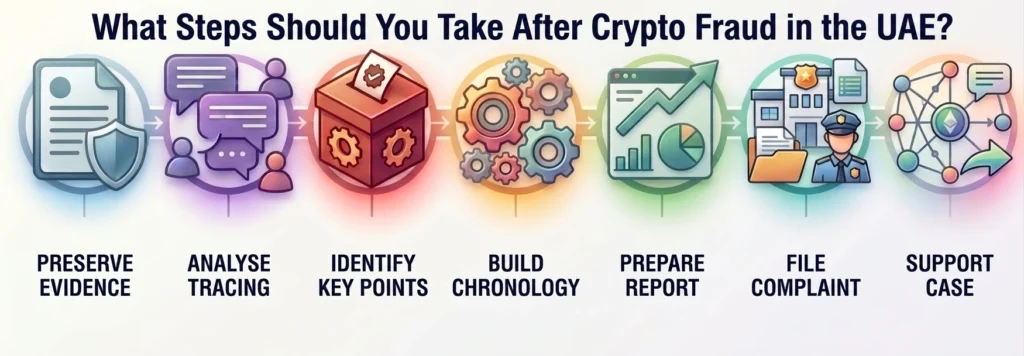
Step 1: Preserve the Evidence
The first requirement is to secure everything connected with the incident before accounts disappear, websites are removed or conversations are deleted.
Relevant evidence may include transaction confirmations, wallet addresses, transaction hashes, exchange records, P2P orders, bank transfers, emails, WhatsApp or Telegram conversations, telephone numbers, usernames, websites and documents provided by the suspected fraudster.
Original records are generally more useful than isolated screenshots. Where possible, the information should be preserved in its original form and kept together.
The purpose at this stage is not to investigate the fraud yourself. It is simply to ensure that the information required for a proper analysis is not lost.
Step 2: Analyse Where the Crypto Actually Went
The wallet that first received the cryptocurrency may only be the beginning of the transaction trail.
Fraud proceeds can be transferred through several addresses, divided into smaller amounts, combined with other funds, exchanged into different digital assets or moved between blockchain networks. They may also interact with decentralised platforms or eventually reach centralised exchanges.
This is why checking one receiving wallet does not necessarily explain what happened.
A professional blockchain analysis aims to reconstruct the movement of the relevant funds and identify the significant points in that transaction history.
For example, a victim may know that 50,000 USDT was sent to a particular address. The useful question is not only where that first transfer went, but what happened to those funds afterwards.
Tracing that movement can provide a clearer picture of the fraud and may identify destinations that are relevant to the next stage of the case.
Step 3: Identify Where Further Action May Be Possible
Blockchain tracing becomes especially valuable when the funds interact with an identifiable platform or service.
For example, the transaction trail may indicate that assets eventually reached a centralised cryptocurrency exchange. The blockchain itself may not reveal the legal identity of the person controlling the account, but the exchange may possess customer-identification records that are not publicly available.
A case may also involve a P2P platform, bank transfer or another financial service connected to the movement of funds.
These become important points for further investigation.
Identifying such a destination does not guarantee that the assets can be recovered. What it does is transform the case from a general allegation that “my crypto was stolen” into a more focused investigation supported by transaction evidence.
That distinction can be significant when the matter is later presented to police, lawyers, banks or cryptocurrency platforms.
Step 4: Build a Clear Chronology
Crypto fraud cases are often difficult to understand because several forms of evidence are involved at the same time.
There may be a conversation with the suspected fraudster, a bank payment, a crypto purchase, an exchange order and a blockchain transfer. To the victim, these events are obviously connected. To someone reviewing the case for the first time, that connection may not be immediately clear.
A proper chronology should explain the incident in sequence.
It should establish how the relationship began, what representations were made, why the victim transferred funds, how the payment was made and what happened to the cryptocurrency afterwards.
The technical transaction evidence should support that narrative rather than overwhelm it.
This becomes particularly important in P2P disputes, where the person transferring fiat currency may not necessarily be the same person who ultimately receives the cryptocurrency.
A clear chronology allows the banking, exchange and blockchain evidence to be viewed as one connected financial event.
Step 5: Prepare a Crypto Financial Crime Report
Once the transaction evidence has been analysed, the findings should be converted into a structured report.
A crypto fraud case should not depend on an investigator being able to interpret pages of raw wallet addresses or transaction hashes independently.
The purpose of a professional report is to explain what happened in a clear and technically supported manner.
Depending on the case, the report may bring together the background of the incident, relevant transactions, wallet activity, financial evidence, exchange information and the overall movement of the funds.
Visual transaction mapping may also be used where it helps explain complex movements between wallets or platforms.
Importantly, the report should remain factual and evidence-based. It should explain what the available blockchain and financial information demonstrates without making conclusions that cannot be supported.
The objective is to turn technical blockchain data into usable financial-crime evidence
Step 6: File the Police Complaint With an Organised Case
Once the analysis and report are ready, the matter can be presented to the appropriate authority with a much clearer evidentiary foundation.
The police will create and investigate the official complaint. The role of the supporting report is to help explain the financial and blockchain aspects of the case.
Instead of submitting numerous unrelated screenshots and attempting to explain wallet movements verbally, the victim provides an organised chronology supported by transaction analysis and documentary evidence.
This can be particularly important where the case involves several wallets, exchanges, bank accounts or jurisdictions.
The same report may also be useful when communicating with a lawyer, bank, exchange or another party connected with the investigation.
Step 7: Support the Case as It Develops
A crypto investigation does not necessarily end when the complaint is filed.
New information may emerge. Additional wallet movements may occur, an exchange may request further evidence or investigators may ask for clarification about specific transactions.
Where necessary, the analysis can be expanded or updated as the case develops.
The purpose is to maintain a coherent technical record throughout the investigation rather than treating the original report as an isolated document.
Is Your Stolen Crypto Really Gone? Here’s What You Can Do
No professional investigation can guarantee the recovery of stolen cryptocurrency, and some cases will be more difficult than others.
However, a transfer to an unknown wallet should not automatically be treated as the end of the matter.
The blockchain may still provide evidence of how the funds moved, which platforms they interacted with and where further enquiries may be possible. This is also important under UAE crypto regulations in 2026, which focus on regulating virtual asset businesses and ensuring they follow proper compliance requirements.
The important issue is ensuring that the evidence is analysed professionally before conclusions are reached.
At Tulpar Blockchain, we provide crypto wallet tracking, blockchain transaction analysis and Crypto Financial Crime & Wallet Tracking Reports to help victims turn fragmented evidence into a structured case for police, lawyers, banks and cryptocurrency platforms. Talk to our experts by writing an email at info@tulparblockchain.com or call +971 54 444 5124 for practical guidance tailored to your DAO.
You provide the available evidence. We investigate the transaction trail and turn it into a clear, usable report.
FAQs :
Recovering lost money from a crypto scam is not guaranteed, but tracing the movement of the cryptocurrency may help identify where the funds went and whether they reached an exchange, wallet or other identifiable service. Preserving transaction records and conducting professional blockchain analysis can help establish the available recovery options.
Yes. Many cryptocurrency transactions are recorded permanently on a public blockchain, allowing the movement of funds between wallet addresses to be analysed. However, tracing a wallet does not automatically reveal the identity of the person controlling it. Additional exchange, banking or other records may be required to connect the blockchain activity to an identifiable person or service.
Preserve all available evidence, including transaction hashes, wallet addresses, exchange records, bank transfers, emails and messages with the suspected fraudster. Contact Tulpar Blockchain for professional blockchain analysis and guidance on organising the evidence for your case.