
UAE Crypto Tax: Registration, Advisory and Return Filing in the UAE
If you run a crypto, blockchain or Web3 business in the UAE, a high volume of wallet transactions does not automatically tell you how much tax you owe. The real challenge is determining which transactions represent business income, asset movements, expenses, exempt supplies or taxable services. Understanding UAE crypto tax therefore starts with correctly classifying the activity, not simply counting transactions on the blockchain.
Crypto may move on-chain, but tax obligations do not disappear on-chain, a reality recognized by authorities from the UAE to the IRS through initiatives like the Crypto-Asset Reporting Framework.
A company can receive payment in USDT, hold Bitcoin or Ethereum (ETH) in its treasury, earn staking rewards, charge a wallet-management fee, trade digital assets or NFTs, or pay suppliers in cryptocurrency. To the blockchain, these may simply look like wallet movements. For tax purposes, they can represent very different things: revenue, an asset purchase, an exempt transaction, a taxable service, a business expense or an investment.
That is why “Is crypto taxed in the UAE?” is usually the wrong first question.
The better question is: who is carrying out the activity, what exactly are they doing, and how should each transaction be treated to determine the resulting tax liability for UAE tax purposes?
Is Crypto Taxable in UAE? Understanding crypto tax UAE
The UAE has built a business-friendly environment for digital assets under regulators like VARA, but companies operating in crypto, blockchain and Web3 remain within the UAE tax framework.
UAE companies and other juridical persons are generally within the scope of Corporate Tax. Taxable income starts from the accounting profit or loss shown in the financial statements, with adjustments required under the Corporate Tax Law. Corporate Tax returns are generally filed within nine months after the end of the relevant Tax Period.
For ordinary taxable businesses, the UAE applies a 0% Corporate Tax rate to taxable income up to AED 375,000 and 9% above that threshold. Free Zone businesses are also within the Corporate Tax system; a Qualifying Free Zone Person may benefit from a 0% rate on Qualifying Income if the required conditions are satisfied.
So forming a crypto company in a UAE Free Zone does not automatically mean every source of income is taxed at 0%.
How Does Crypto Tax in UAE Apply to Individual Crypto Investors?
The UAE Corporate Tax rules do not automatically treat every individual tax resident who buys and sells cryptocurrency as a taxable business, as the country does not currently impose a personal income tax on such activities.
A natural person is subject to Corporate Tax where they conduct a Business or Business Activity in the UAE and total turnover from those activities exceeds AED 1 million in a calendar year. The FTA excludes wages, Personal Investment Income and Real Estate Investment Income from this Business or Business Activity calculation.
This means an individual holding digital assets personally should not automatically be treated in the same way as a licensed crypto trading company.
Classification matters. The nature of the activity, how it is organised and the capacity in which the transactions are undertaken need to be considered before deciding whether the income is business income, Personal Investment Income, or subject to a specific capital gains tax framework.
How Is Crypto Tax in Dubai Calculated on Business Profits?
One common crypto accounting mistake is confusing transaction volume with taxable profit.
Imagine a company buys crypto for AED 2 million and later sells it for AED 2.15 million. The blockchain may show AED 4.15 million of movements, but that does not mean AED 4.15 million is taxable profit.
The tax analysis must identify cost, sale proceeds, realised gains or any specific crypto losses, fees and relevant adjustments. The problem becomes more difficult when a business has thousands of transactions across exchanges, DeFi protocols, self-custody wallets and multiple blockchains.
Transfers between wallets controlled by the same company may not represent revenue. A token received from a customer may be revenue. Gas fees, exchange charges, token swaps, airdrops, hard forks and other movements also need proper classification.
Wallet data alone is not a tax return.
How Does VAT Apply to Crypto in the UAE?
VAT and Corporate Tax should not be mixed together.
The FTA has clarified that the transfer of ownership and conversion of qualifying virtual assets — including buying and selling cryptocurrencies on an exchange — are exempt from VAT, with the exemption applying from 1 January 2018.
That does not mean every crypto-related service is VAT-exempt.
For example, the FTA states that keeping and managing virtual assets and enabling control over them, such as managing crypto wallets, is taxable where supplied in the UAE for an explicit fee, commission or similar charge.
This distinction matters for exchanges, brokers, custodians and wallet providers. The virtual-asset transaction itself may be exempt while the fee earned around that transaction may have a different VAT treatment.
VAT registration is based on taxable supplies and imports. A UAE business must generally register when these exceed AED 375,000, while voluntary registration may be available above AED 187,500. A crypto business should therefore not simply use its total token-trading volume to determine whether the VAT threshold has been exceeded.
Does Accepting Crypto Payments Affect UAE Tax?
Suppose a blockchain consultancy issues an invoice for AED 50,000 but accepts the equivalent amount in USDC or other stablecoins.
The fact that payment arrives in crypto does not change the underlying commercial transaction. The business still supplied a consultancy service and must determine the correct accounting and VAT treatment.
It must also record the fair market value received and account for what happens if the digital asset is later held, converted or disposed of.
This valuation issue has become increasingly important. In July 2026, the FTA published a specific VAT directive dealing with the method of converting the value of digital currencies into UAE dirhams, aligning with global standards like the OECD CARF and further underlining the need for consistent and supportable valuation records.
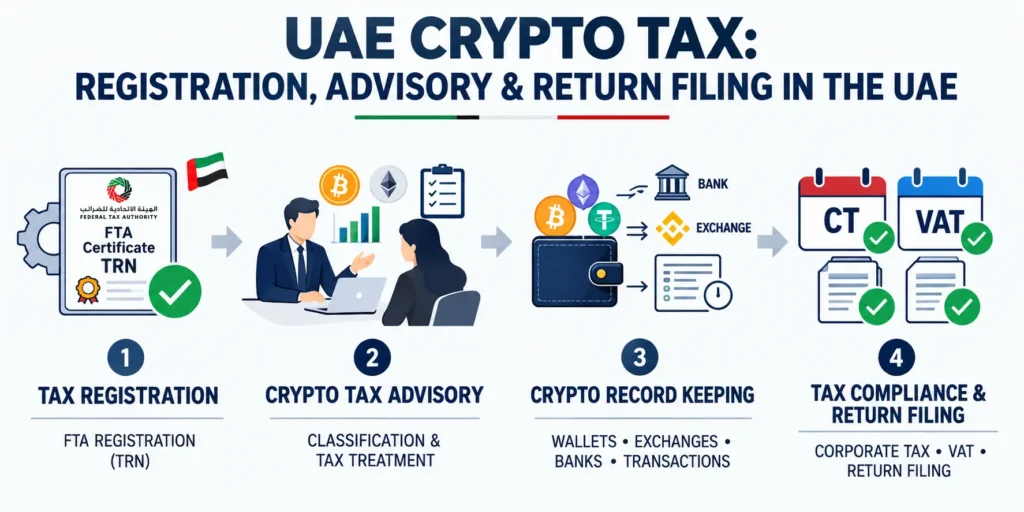
What Does UAE Crypto Tax Registration Involve?
Crypto tax compliance is not simply obtaining a TRN.
A business needs records that can explain what happened during the tax year. That may require reconciling bank accounts, exchange accounts and blockchain wallets; identifying company-controlled versus personal wallets; classifying token receipts and disposals; documenting valuations; and separating taxable, exempt and other transactions.
For VAT-registered businesses, returns and related VAT payments are generally due within 28 days from the end of the tax period. Corporate Tax operates separately, with the return and payment generally due within nine months after the end of the Corporate Tax period.
If the accounting records and wallet history do not reconcile, filing the return does not solve the problem — it simply transfers that problem into a filed tax position.
Why Crypto Tax Advisors in Dubai Matter Before Filing
The best time to consider crypto tax is not the week before the return deadline.
A business launching a token, accepting cryptocurrency from customers, holding a crypto treasury, operating wallets or charging transaction fees should understand the tax treatment before large transaction volumes accumulate.
The structure of the business can affect Corporate Tax. The nature of the service can affect VAT. Wallet control affects accounting evidence. Valuation affects the numbers ultimately reported.
At Tulpar Blockchain, our crypto tax registration, advisory and return-filing work connects blockchain activity with UAE tax compliance — translating wallet and transaction data into records that can support a defensible tax position and return. If you need help determining the correct treatment of your crypto activities Contact expert for professional guidance tailored to your business, email info@tulparblockchain.com or call +971 54 444 5124.
FAQs :
Crypto does not have one single tax treatment in the UAE. Corporate Tax may apply to businesses conducting taxable activities, while VAT treatment depends on the nature of the virtual-asset transaction or related service. The taxpayer’s circumstances and activity must therefore be assessed before determining the applicable treatment.
Individual investors are not automatically subject to Corporate Tax simply because they buy or sell cryptocurrency. A natural person is subject to Corporate Tax where they conduct a Business or Business Activity in the UAE and the relevant turnover exceeds AED 1 million in a Gregorian calendar year, subject to the applicable rules.
A UAE crypto company may fall within the UAE Corporate Tax regime and may have registration and filing obligations depending on its status and activities. Operating from a Free Zone does not automatically remove the company from Corporate Tax or guarantee a 0% rate on all income.