The Difference Between a Blockchain and a Token
Michael Hofer, Hands-on CTO for Agentic AI & Blockchain, 20 years building enterprise software and data systems. Contributor, Tulpar Blockchain Insights.
The question comes up in almost every conversation about digital assets, and it usually arrives in the same shape: it is just data, isn’t it.
It is. The conclusion people draw from it is what goes wrong. A share is also just an entry in a register, and nobody would accept that as an argument for why a share is worthless. The difference between a blockchain and a token is the difference between the register and the entry in it. Once that is clear, the question of value becomes answerable.
The register and the entry
A company keeps a register of members. The value of a share does not come from that register. It comes from what the share is a claim on: future profits, a vote, a residual claim if the company is wound up.
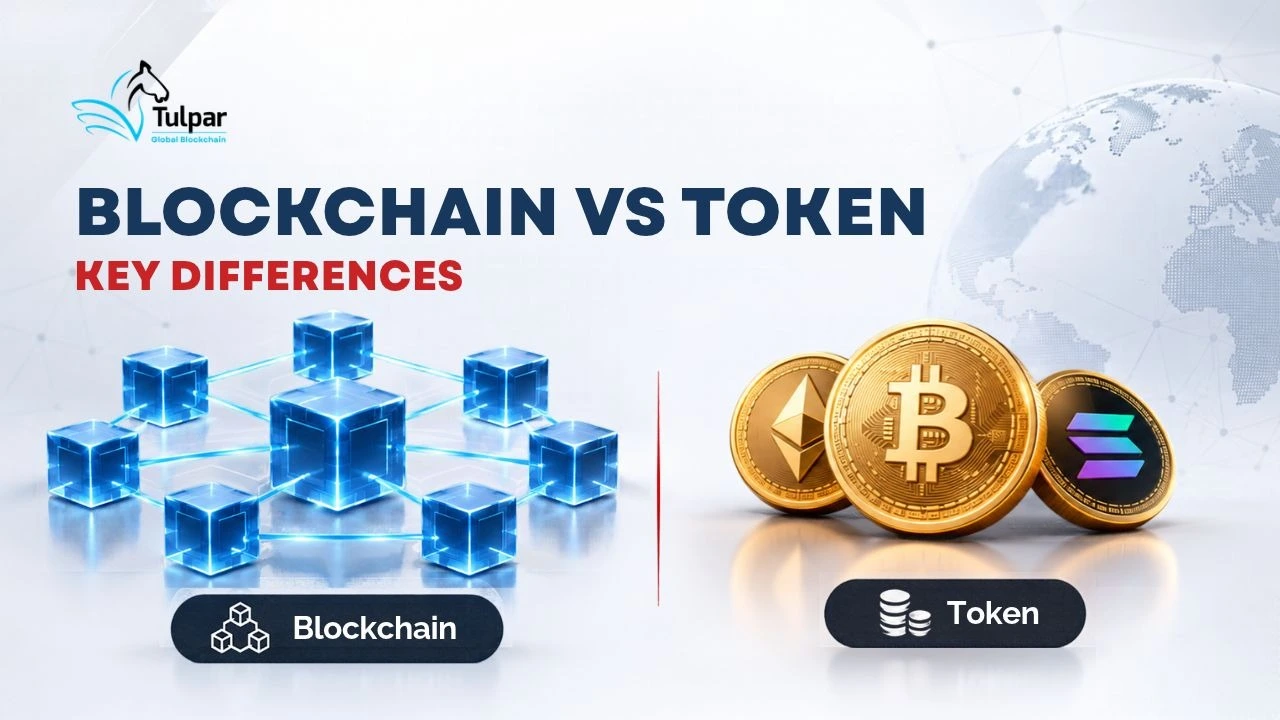
A blockchain is a register, and a token is an entry in it. The chain records who holds the entry and makes sure nobody spends it twice. What the entry is worth is a separate question, and the chain has no opinion on it. It records a claim on a gold bar as faithfully as a claim on nothing at all.
Two kinds of entry
The register holds two different kinds of entry, and most of the confusion starts when they are treated as one.
The first is the register’s own currency. Bitcoin, Ether, XRP and SOL are not issued by anyone. The protocol creates them, they pay the network’s fees and, on most chains, they secure it.
Bitcoin does not even keep balances: what a wallet shows is the sum of unspent coins from earlier transactions.
The second is a sub-register that someone opened on top. Most tokens on Ethereum, USDC among them, are small programs that follow a common standard called ERC-20. Your balance is a line in that program’s storage. Solana and the XRP Ledger have their own equivalents.
The difference is who keeps the register. To change the rules of Bitcoin, you have to convince the network. To change the rules of an issued token, you often only have to convince whoever holds the contract’s admin key. Many token contracts can mint new supply, freeze balances or be replaced with new code. Regulated tokens need some of that, since a tokenised security has to be able to refuse a transfer to someone who may not hold it. But the holder of an issued token holds an entry in a register somebody else can edit.
What the entry is a claim on
For issued tokens, the useful question is not which chain. It is what the entry gives you a right to.
An asset held elsewhere. Each PAXG token from Paxos corresponds to one fine troy ounce of London Good Delivery gold in a London vault. Franklin Templeton has run a US money market fund on a public blockchain since 2021, BlackRock launched BUIDL in 2024, and tokenised property shares belong here too. The token does not remove the need to trust someone. It changes who you trust and makes the claim easier to move and to inspect.
An issuer’s promise. A stablecoin like USDC is weaker than it looks. PAXG points at specific bars. USDC is a claim on a pool of reserves, good as long as the issuer stays solvent and willing to redeem. Algorithmic stablecoins replaced the reserves with confidence, and TerraUSD showed in 2022 what that is worth once confidence leaves.
A share of a pool. Deposit into a lending protocol or a staking service and you get a receipt token. It is a claim on whatever the pool holds when you redeem, and the risks stack: a receipt on staked Ether carries the risk of the protocol, the staking service and Ether itself. On screen it looks like any other token.
A service or a vote. Utility tokens follow demand for the service. Governance tokens are worth what the treasury and the decisions are worth, which is often less than the documentation suggests.
Nothing at all. Pump.fun on Solana produces tokens whose only claim is on the next buyer, and to its credit, it does not pretend otherwise.
None of this shows in the code. A contract can be audited, immutable and efficient and still be a claim on nothing. Technical quality protects the entry, not the value behind it. That matters, because the audit report is often the only document an investor reads.
Three reasons an entry is worth something
Someone is obliged to give you something for it. That covers asset-backed tokens, stablecoins and pool receipts. The value sits off the chain, and so does the risk.
You need it to do something. Ether pays for every transaction on Ethereum. The value follows the use.
Or it is a monetary good. This is Bitcoin. Nobody owes you anything for a bitcoin, and you need it for nothing except Bitcoin itself. Its value comes from a supply capped at 21 million, a fixed issuance schedule and the fact that no company or government can change either. Gold works the same way: a bar of gold is a claim on nobody.
The cap is not a law of nature, though. It is a rule in software that has held for more than fifteen years because the people running the network refuse to change it. A fixed supply is easy to copy, and anyone can deploy a token with one in an afternoon. What cannot be copied is a network where nobody is in a position to change it.
Most native coins are a mix. Ether is partly monetary as well, since part of every fee has been burnt since 2021. XRP pays its ledger’s fees, but it was created in full at launch and a large share has sat in escrow with one company. A different bet from Bitcoin, not necessarily a worse one.
What the books see
A company paid in USDC, a gold trader holding PAXG next to physical bars, a developer selling property shares as tokens and a miner paid in new bitcoin all hold entries on a chain. They do not hold the same thing, and their accounts will not treat them alike. Regulators draw the same lines with different labels: Switzerland’s FINMA speaks of payment, utility and asset tokens, the EU’s MiCA and the UAE regulators use their own categories. The question underneath stays the same.
Four questions
Before buying, accepting or issuing anything on a chain, ask what the entry is a claim on, who is obliged to honour it, who can change the rules of its register and what would make the claim fail.
Holding several tokens is not diversification until you can answer those four for each one.
The register can prove who holds the entry. Only the claim behind it can make the entry worth holding.