
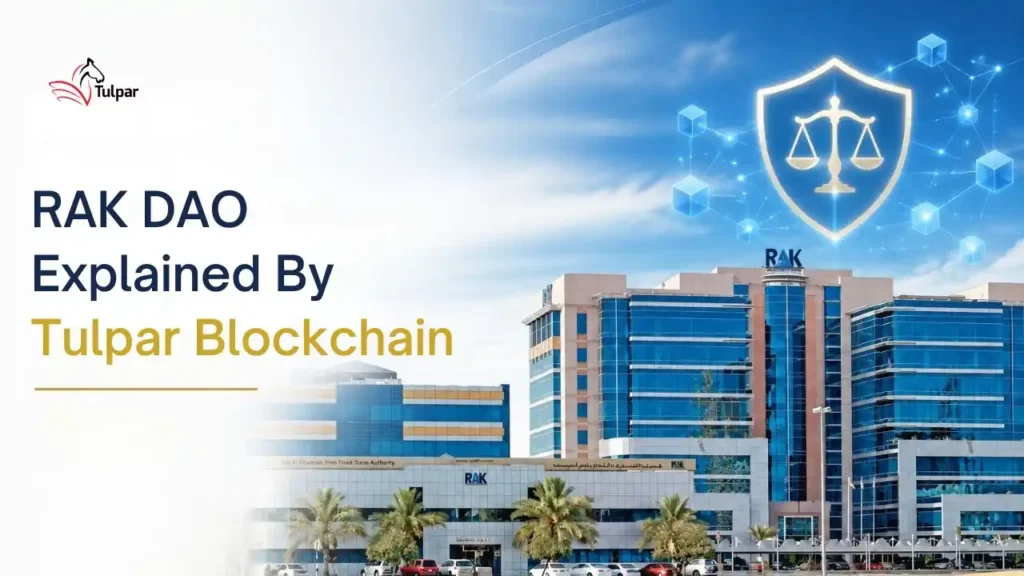
Your DAO just approved a major deal. The community voted. The smart contract executed. The funds are ready. But who is legally signing the contract?
This is where decentralised organisations can hit a wall.
A DAO can vote. It can hold a digital treasury. It can approve proposals, distribute funds and even execute decisions automatically through smart contracts.
Ras Al Khaimah has developed a dedicated framework designed to bridge those two worlds. Originally established as RAK Digital Assets Oasis, commonly known as RAK DAO, the free zone was officially renamed Innovation City under Ras Al Khaimah Law No. 4 of 2025. Its DAO Association framework nevertheless provides a specific legal route through which qualifying decentralized organisations can establish a recognised corporate structure in the UAE.
This guide will help founders exploring UAE DAO incorporation, Web3 projects considering legal structuring, and anyone looking to understand how DAO governance connects with legal compliance. Not every DAO looks the same, and the framework reflects that.
A smaller, community-run project with under 100 members can typically
register as a Startup DAO through a lighter setup path,
while a DAO managing a treasury above $1 million generally falls under the Alpha DAO category,
with more extensive governance and compliance expectations.
Knowing which tier your DAO fits before you start the process shapes almost every decision that follows.
DAO stands for Decentralized Autonomous Organisation.
Instead of relying entirely on a conventional hierarchy of shareholders, directors and executives, a DAO can use blockchain technology to distribute decision-making among its members.
Members may hold governance tokens which allow them to submit proposals or vote on matters such as:
Smart contracts can then automate parts of these processes. A smart contract is essentially blockchain-based software programmed to perform an action when predetermined conditions are satisfied.
For example, a proposal might request that 100,000 USDC be allocated from the DAO treasury to develop a new product. Token holders vote. If the required voting threshold is reached, the transaction can potentially be executed according to the DAO’s smart-contract rules.
The RAK DAO Association Regulations expressly recognise governance proposals relating to projects, funding, treasury management and protocol development.
Running an organisation entirely on-chain creates a practical problem.
A blockchain address is not automatically a legal entity.
The DAO may control millions of dollars in digital assets, but counterparties still need to know who they are contracting with. Banks, employees, landlords, developers, auditors and professional advisers normally deal with recognised legal persons.
Without an appropriate legal wrapper, questions can arise around liability, ownership of intellectual property, contracts, taxation, employment arrangements and responsibility for the DAO’s activities.
The Ras Al Khaimah framework attempts to solve this through the DAO Association.
Under the DAO Association Regulations, an incorporated DAO Association becomes a separate body corporate with its own legal personality. It can enter legally binding obligations and acquire, possess and dispose of assets in its own name. Its liabilities are generally liabilities of the DAO Association itself rather than the personal liabilities of its members or officers, subject to the Regulations.
That distinction is significant: the DAO’s digital governance can sit behind a recognised legal structure capable of operating in the conventional economy.
RAK Digital Assets Oasis (RAK DAO) was established under Ras Al Khaimah Law No. 2 of 2023 as a dedicated free zone for digital asset and virtual asset businesses. It is designed to support Web3 founders, blockchain projects, NFT platforms, decentralised applications and crypto-native businesses looking for a suitable base in the UAE.
It is important to note that RAK DAO acts as a business registration authority rather than a financial regulator. Businesses carrying out regulated activities such as virtual asset exchanges or custody services may need to obtain separate regulatory approval from VARA or the SCA, depending on the nature and location of their activities. Businesses can apply for a RAK DAO licence based on their approved activities and use the free zone as a base for eligible digital-asset operations.
The legal structure does not simply replace decentralized governance with a traditional company board.
Instead, the framework is designed to connect on-chain governance with off-chain legal responsibilities.
At least two founding members are required to apply for incorporation. The application must address matters including the DAO’s activities, governance and dispute-resolution mechanisms, token structure, treasury-management processes and the smart contracts used by the DAO.
A Constitution then defines how the organisation operates.
The DAO can have governance token holders who participate in proposals and voting, while a Council deals with functions that require identifiable individuals to act for the legal entity.
A Manager or Registered Agent must also be maintained to handle administrative and compliance functions and communications with the Authority. Subject to the required approvals, that person can enter contracts and other legal arrangements on behalf of the DAO Association.
In other words, decentralization does not mean the absence of accountability. It means designing which decisions belong to the community, which are automated through code and which require authorised legal representatives.
Token design is particularly important when establishing a DAO.
A governance token is not simply a cryptocurrency placed on a blockchain. Its rights need to correspond with the DAO’s Constitution, voting procedures and legal structure.
The Regulations allow governance proposals to deal with areas such as treasury management, project initiation, funding and protocol development. Voting requirements, eligibility, quorum and approval thresholds can then be established through the Constitution.
RAK’s framework also recognises other types of tokens associated with participation, access, services or contributions to the DAO. Different token classes may therefore carry different rights and obligations.
This makes tokenomics a legal and governance issue as much as a technical one.
Potentially, but incorporation does not mean unrestricted token issuance.
Where a DAO Association proposes a new class of tokens, the Regulations require documentation including a white paper or equivalent document describing the token structure, supply, distribution, vesting, utility and governance features.
A legal opinion is also required confirming compliance with applicable UAE law and addressing whether the proposed token constitutes a security token. Relevant smart contracts must additionally undergo a cybersecurity audit.
The DAO Association must also obtain a No Objection Certificate from the Registrar before issuing a new token class or listing its tokens on a regulated market or exchange.
This is an important distinction. Creating a DAO Association does not override UAE virtual-asset, securities, AML or other federal regulatory requirements.
The correct regulatory route depends on what the DAO actually intends to do.
Decentralized does not mean undocumented.
DAO Associations must maintain appropriate records and prepare annual accounts. The accounts must present a true and fair view of the organisation’s financial position and results.
The framework also requires the annual accounts to be examined by an auditor, with audited accounts filed with the Registrar. An annual return must separately be submitted following the end of each financial year.
This becomes particularly important where treasury activity involves multiple wallets, tokens, staking arrangements, smart-contract transactions or movements between fiat currency and digital assets.
Blockchain transparency can show that a transaction occurred. It does not automatically determine its accounting treatment, tax treatment, beneficial ownership or commercial purpose.
The structure may be relevant to Web3 projects where governance genuinely involves a distributed community, including protocol DAOs, developer communities, ecosystem organisations, blockchain foundations, token-governed projects and organisations managing community treasuries.
However, forming a DAO should not begin with the question, “How do we register it?”
It should begin with:
What is the DAO actually designed to do?
The answer determines the appropriate governance structure, token model, smart-contract architecture, licensing requirements, tax treatment and compliance obligations.
A well-designed DAO is not simply an organisation without a CEO.
It is an organisation where code, community voting and legal authority are deliberately connected.
The development of the RAK DAO framework — now operating under Innovation City’s regulatory structure — represents an important step toward making that connection possible in the UAE.
Setting up a DAO in the UAE involves more than registering an entity. You need to consider the DAO’s purpose, governance model, token structure, legal framework, licensing requirements and ongoing compliance before choosing the right structure. Due to Tulpar Blockchain working in close partnership with Innovation City, we are able to obtain close exposure to the ecosystem supporting Web3 and digital-asset businesses in Ras Al Khaimah, including organisations exploring DAO structures. This helps founders build a DAO with its on-chain governance and legal structure working together from the start.
For professional guidance tailored to your business, contact Tulpar Blockchain at info@tulparblockchain.com or call +971 54 444 5124.
RAK DAO, now operating under Innovation City, provides a framework through which qualifying decentralized organisations can establish a recognised legal structure in the UAE. This allows the DAO to enter contracts, hold assets and manage legal responsibilities through a separate legal entity.
A DAO Association can potentially issue tokens, but incorporation does not automatically permit unrestricted token issuance. Depending on the token and its intended use, the DAO may need a white paper, tokenomics documentation, legal opinion, cybersecurity audit and No Objection Certificate, along with compliance with applicable UAE regulations.
Yes. DAO Associations must maintain financial records, prepare annual accounts and meet applicable audit and filing requirements. The DAO’s blockchain transactions may also create accounting, tax and compliance obligations, depending on its activities and structure.
The RAK DAO licence cost varies based on the business activity, licence package, premises and additional requirements such as visas. Applicants should check the current fees with the authority because setup costs can vary based on the company’s requirements.
Blockchain, Web3, technology assurance, digital analytics and multidisciplinary professional advisory services.
Copyright © 2026 TulparGlobal Blockchain. All Rights Reserved. By TGB