What Is a DAO? Understanding the Infrastructure Behind a Successful DAO
Behind every effective DAO is more than a voting mechanism. The organisation still needs clear rules, financial controls and a structure that can support it as it grows.
With projects that have only a handful of people, decision-making can be pretty simple. Anyone can talk about an idea, decide what to do and then take action.
What will happen however when the community expands to hundreds or thousands of people? This might mean more decisions to take, greater budgets to manage and increased numbers of interested parties wanting some kind of say in the running of the project. It can get difficult to have a single owner or just a few member management team.
This is part of the reason why businesses and Web3 projects are looking into DAOs, or Decentralised Autonomous Organisations. As Blockchain in UAE adoption continues to develop, more organisations are exploring decentralised models and blockchain-based infrastructure.
What is DAO?
A DAO, or Decentralised Autonomous Organisation, is a blockchain-based structure that allows a group of people to make collective decisions without relying entirely on a traditional management hierarchy.
A DAO may be created to govern a blockchain protocol, manage a community treasury, fund projects, coordinate contributors or oversee a wider Web3 ecosystem. Instead of decisions being made only by directors or executives, members participate through a governance system established by the organisation.
The idea is relatively simple: distribute decision-making across a community and use blockchain technology to make that process more transparent.
The more difficult part is making the organisation work once the community, treasury and number of decisions begin to grow.
How Does a DAO Work?
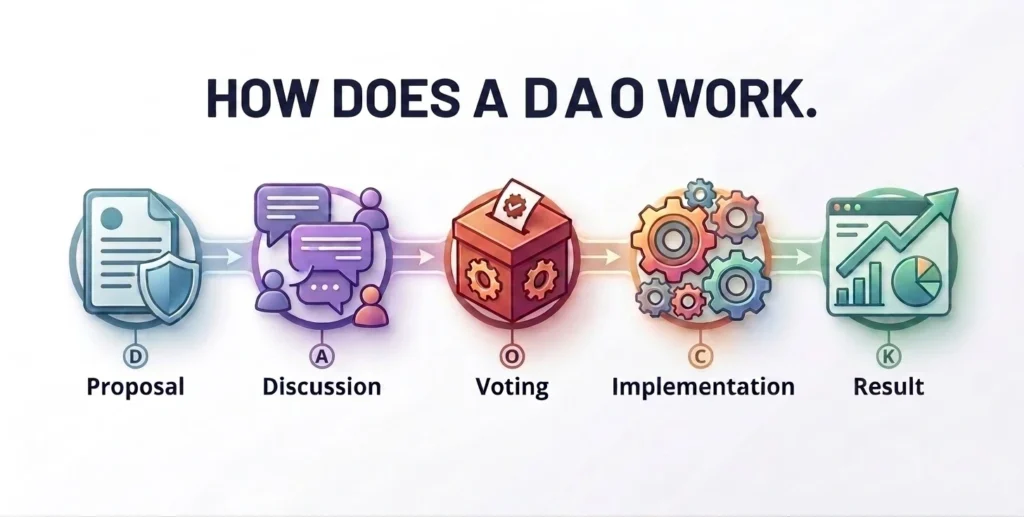
A DAO normally begins by defining its purpose and deciding who should have a voice in its governance.
Some organisations use governance tokens, where voting rights are linked to token holdings. Others use membership rights, NFTs or delegated voting systems.
The rules then determine who can submit proposals, who can vote, how much participation is required and what level of approval is needed before a decision passes.
For example, a DAO may consider a proposal to allocate 250,000 USDC from its treasury to fund a development project. Members review the proposal and vote according to the organisation’s governance rules.
Smart contracts can be used to enforce those rules and, in more automated structures, execute an approved action once the required conditions have been met.
A DAO in blockchain uses this underlying technology to create a transparent connection between proposals, community votes and the transactions that follow.
This is one of the most powerful features of DAO governance.
But the technology only carries out the system that has been designed. The organisation still needs to decide what should require a vote, what level of approval is appropriate and how responsibility should be divided.
How a DAO Decides Who Has Authority ?
A successful DAO cannot put every decision in front of the entire community.
A routine operating expense should not necessarily require the same level of approval as changing the organisation’s governance rules or transferring a significant amount from the treasury.
If every minor decision requires a community-wide vote, the DAO can become slow and difficult to operate. If too much authority is concentrated in a small group, the organisation may begin to lose the decentralised oversight it was created to provide.
The governance structure therefore needs to distinguish between different types of decisions.
Routine operational matters may be delegated to contributors, committees or working groups within defined limits, while major financial or strategic decisions remain subject to wider community approval.
Good governance is not about creating the largest possible number of votes.
It is about establishing who can decide what, under which conditions, and with what level of accountability.
That balance becomes increasingly important as the DAO develops.
How DAO Treasury Governance Protects Digital Assets ?
The treasury is often one of the DAO’s most important assets.
It may contain stablecoins, governance tokens, cryptocurrencies and other digital assets used to fund development, contributors, grants and operating costs.
Securing those assets is obviously important, but treasury governance goes further than preventing unauthorised transfers.
The DAO needs to establish which expenditures require approval, how spending limits work, when authority can be delegated and how significant commitments are documented.
There is also a difference between being able to see a transaction and understanding what it means.
A blockchain record may show that 100,000 USDC was transferred following an approved proposal. That does not necessarily explain whether the payment is related to a development contract, community grant, professional service or another commitment.
It may also not explain whether milestones apply, whether further amounts remain payable or what the transaction means for the organisation’s financial position.
That wider information matters.
As activity increases, the DAO needs to be able to connect financial transactions with the decisions and documents behind them.
Otherwise, an organisation can have a completely transparent treasury while still having poor financial visibility.
What Happens When a DAO Grows?
Many DAOs begin relatively informally.
The original contributors know one another, understand how decisions are made and remember why previous payments were approved.
That works while the organisation is small.
Growth changes the situation.
More members participate, contributors join and leave, the treasury becomes larger and the number of proposals increases. Commercial arrangements may also become more complex as the DAO begins working with developers, professional advisers, service providers or institutional partners.
At that stage, relying on community memory becomes increasingly difficult.
A proposal may begin in one discussion channel, move to a governance forum, proceed to a vote and later result in a treasury payment. Supporting budgets, agreements and project updates may sit in several different places.
Without organised records, a new contributor may be able to see that a payment took place but have no easy way of understanding why it happened or what obligations remained afterwards.
This is where operating procedures, recordkeeping and reporting start to become part of the infrastructure of the organisation.
The DAO needs a reliable record of its major decisions, financial commitments and governance activity so that the organisation does not depend entirely on the people who happened to be present at the beginning.
Reporting also makes transparency more useful.
Rather than expecting members to analyse thousands of wallet transactions themselves, structured treasury reporting can show what assets are held, where significant funds were allocated and what major commitments remain.
Governance reporting can similarly provide a clearer picture of important proposals, decisions and ongoing initiatives.
The result is not less decentralisation.
It is a more informed form of decentralisation.
Building the Infrastructure Around the DAO
A DAO therefore needs more than a mechanism for voting.
It needs governance rules that fit its purpose, a sensible division of authority, proper treasury controls and records that allow decisions and financial activity to remain understandable as the organisation develops.
The technology provides the infrastructure for decentralised participation.
The organisational framework is what allows that participation to remain effective when the DAO becomes larger and more complex.
Talk to our experts at Tulpar Blockchain for professional guidance on DAO governance, treasury management, reporting and ongoing administration. Email us at info@tulparblockchain.com or call +971 54 444 5124 for practical guidance tailored to your DAO.
Creating a DAO can be relatively straightforward. Building the structure that allows it to operate effectively over time is where the real work begins.
FAQs :
DAO is a blockchain based organisation which operates on the principles of collective decision making through governance rules and voting mechanisms instead of relying solely on centralised management.
A DAO needs a legal structure to manage assets, contracts, responsibilities and operations effectively. Choosing the right structure also helps align governance, treasury management and regulatory requirements with the DAO’s activities as it grows.
If you are searching for practical support to structure and manage a DAO, we at Tulpar Blockchain can help with governance, treasury management, reporting, recordkeeping and ongoing administration, providing the operational structure needed as your DAO grows.
RAK DAO, or Ras Al Khaimah Digital Assets Oasis, is a UAE free zone focused on digital assets, blockchain, Web3, and emerging technologies. It provides a business environment for companies operating in these sectors, supporting innovation while businesses remain subject to applicable UAE laws and regulatory requirements.