When Blockchain Records Everything, What Is Left for UAE Auditors to Check?
A blockchain will tell you that 500,000 USDT moved from one wallet to another on a Tuesday afternoon. It will tell you the exact block, the fee paid, and the balance in both wallets before and after. What it will not tell you is whether that transfer was customer revenue, a loan repayment, a supplier payment, a shareholder contribution or a company moving its own money between its own two wallets.
That gap is where digital asset auditing actually lives.
UAE businesses adopting blockchain settlement often assume that perfect transaction records make the audit simpler. In practice, transparency changes the nature of the work rather than removing it. The auditor is no longer searching for transactions; the auditor is testing whether the company can explain them. Ownership, valuation, completeness and accounting treatment all remain open questions long after the chain has confirmed the transfer.
How Auditors in UAE Verify Digital Asset Ownership ?
Digital assets introduce a different way of thinking about ownership and control.
With a conventional bank account, an auditor can often obtain external confirmation showing that an account belongs to a particular company and confirming the balance held at a specific date. A crypto wallet works differently. Its address may be publicly visible, but there is usually no company name attached to it on the blockchain.
That means a wallet containing millions of dirhams in digital assets cannot simply be accepted as a company asset because management says it belongs to the business. There needs to be evidence connecting the wallet to the entity being audited.
This may involve reviewing custody arrangements, wallet records, internal access procedures, transaction histories and the way private keys or signing rights are controlled. If the company uses a multisignature wallet, for example, the auditor may need to understand who the authorised signatories are and how transactions are approved. If assets are held with a third-party custodian or on a centralised exchange, the evidence will be different again.
The key issue is whether the company can demonstrate that it genuinely owns or controls the assets being reported. This becomes particularly important when wallets are managed personally by founders, directors or employees, because the question quickly moves beyond accounting and into governance and internal control.
How the Value of Digital Assets Is Determined ?
Once ownership is established, the next question is value.
For a widely traded asset such as Bitcoin, finding a market price may appear relatively straightforward. Even then, prices can differ between exchanges and move throughout the day, meaning the valuation source and methodology still matter.
For smaller or less liquid digital assets, the issue becomes more complicated. A company might hold several million units of a token that appears to have a substantial market value. On paper, the calculation seems simple: multiply the number of tokens by the quoted market price.
But that assumes the quoted price represents a market in which the company could realistically transact.
The number visible on a price-tracking platform may therefore be very different from the economic value that can reasonably be supported in the financial statements. Valuation can require consideration of the relevant market, the reliability of pricing sources, liquidity, trading volume and any restrictions surrounding the asset.
How Crypto Transactions Are Recorded Across Different Platforms ?
Another misconception is that every crypto transaction is visible individually on the public blockchain.
That is not always the case.
A company can transfer funds to a centralized exchange and then carry out dozens or even thousands of trades within that platform. The blockchain may show the original deposit and the eventual withdrawal, but the buying, selling, conversions and trading fees taking place inside the exchange are recorded in the exchange’s own systems.
An auditor reviewing only the blockchain would therefore see only part of the picture.
To reconstruct the company’s actual digital asset activity, on-chain records may need to be reconciled with exchange statements, transaction exports, deposits, withdrawals, trading histories and fees. If several exchanges and wallets are used, the process becomes more complex because the same asset may move through multiple platforms before returning to a corporate wallet.
This is where weak recordkeeping can create problems at year-end. Every transaction may technically exist somewhere, but the information can be fragmented across systems that have never been properly reconciled. By the time the audit starts, the finance team may be left reconstructing months of activity after the fact.
How DeFi Transactions Work
The challenge becomes even more interesting when a business interacts with decentralised finance.
A company may stake digital assets, provide liquidity, lend tokens through a protocol, borrow against crypto collateral or receive protocol rewards. Each transaction is recorded on-chain, but understanding its financial substance requires more than reading the transfer history.
Consider a liquidity pool. A company may deposit two assets into a decentralised protocol and receive another token representing its interest in the pool. Technically, the transaction is visible. Financially, several questions immediately arise.
What exactly does the company continue to own? How should the new token be treated? When should rewards be recognised? How should changes in the underlying position be reflected?
These situations show why digital asset auditing increasingly requires an understanding of both finance and the mechanics of blockchain transactions. An auditor does not necessarily need to analyse the code behind every protocol, but there needs to be enough understanding of the transaction to determine what economic event actually took place.
Without that context, a transaction can be recorded perfectly on-chain and still be misunderstood in the accounts.
Understanding Blockchain and Smart Contract Audits
The term “blockchain auditing” can also cause confusion because it is used to describe very different types of review.
A smart contract code audit generally focuses on the technical integrity of software. It looks for vulnerabilities, security weaknesses and situations where the contract may not behave as intended.
A blockchain and digital asset financial audit focuses on something different: the financial consequences of what happens on-chain.
If a smart contract distributes tokens, generates rewards or moves assets between wallets, the financial questions concern how those transactions were recorded, whether resulting balances were recognised appropriately and whether the company has adequate evidence to support them.
A smart contract can therefore function exactly as designed while the accounting treatment surrounding it is still incorrect. The two forms of review can complement each other, but they solve different problems.
Why Digital Asset Auditing Matters for Businesses
Digital asset auditing is no longer relevant only to cryptocurrency exchanges, token issuers or blockchain startups.
Traditional businesses are increasingly encountering digital assets in ordinary commercial situations. A trading company may accept stablecoin payments from overseas customers. An investment company may hold Bitcoin as part of its portfolio. A technology business may receive tokens under a commercial agreement, while another company may use blockchain-based settlement for cross-border transactions.
The moment digital assets enter a business, they also enter its financial reporting environment.
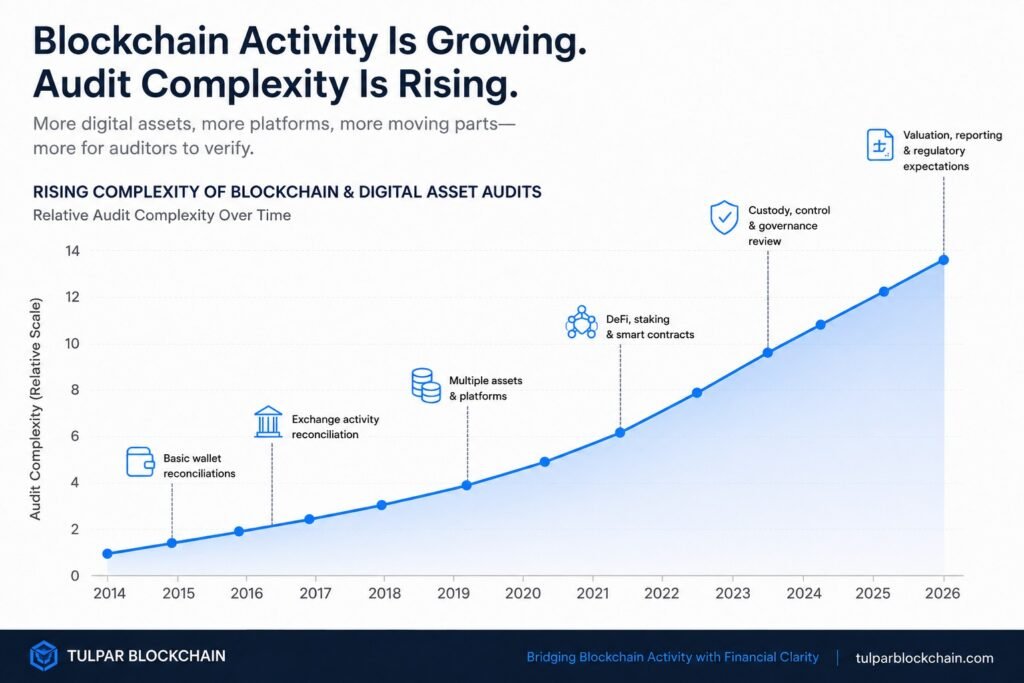
Companies need to know where those assets are held, who controls them, how they are valued and how material transactions are being reflected in the accounts. The difficulty often appears when digital asset activity grows faster than the company’s internal systems.
A business may begin with one wallet and a handful of transactions, then gradually add more wallets, exchange accounts and digital assets without creating a structured process for reconciliation and control. Everything may appear manageable until management, an auditor, a regulator or an investor asks for a complete financial picture.
At that point, the issue is no longer whether the transactions can be found. It is whether the company can explain them clearly.
Why Proper Digital Asset Records Matter for Auditing
Digital asset auditing is about more than checking blockchain transactions. Businesses need to prove ownership, value assets correctly, track transactions and connect blockchain activity with financial records. If you need support in understanding and organising your digital asset records.
Tulpar Blockchain can help bring greater clarity to wallet activity, exchange records, asset balances and related financial information. Contact our team to discuss your digital asset audit and reporting requirements. Contact expert for professional guidance tailored to your business, email info@tulparblockchain.com or call +971 54 444 5124.
FAQs :